Chapter OneThe Wide Lawns
We shall not cease from exploration.
T. S. Eliot
Launch sale — 25% off: $104.25 instead of $139. Get it before it ends
Import the manuscript you have been writing in Word. Choose a design. Export a print-ready PDF and an EPUB the shops will accept — all of it in your browser, with nothing to install.
$139 $104.25 — launch price, ends soon
Same words on both sides. Drag the handle.
The left half is a real Word file —download manuscript.docxand picture yours in its place.
Exports to the specification of the shop you are publishing to
Every spread below is a real export: the same manuscript, typeset by the same engine that will set your book, at the trim size the design is drawn for. Pick the one you want to start from. Nothing in it is locked afterwards.
Hand-set trade typography: a Goudy old style, small-caps chapter titles, a fleuron and a three-line initial.
We shall not cease from exploration.
T. S. Eliot
They came down through the orchard in thelast of the light, and the grass was already wet.Nobody spoke about the letter. It had been readaloud twice at lunch and there was nothing further in itthat a third reading would find.
The path bent left at the wall and then ran straight fora hundred yards under the limes, which had been plantedclose and had grown into one another, so that walkingbeneath them was like walking along a corridor with agreen ceiling. At the end of the limes there was a gate, andbeyond the gate the ground fell away sharply to the river,which at that hour was the only bright thing in the valley.
Clare walked ahead, as she always did, and her fathercame behind with his hands pushed into his pockets andhis collar up, though it was not cold. He had not spo‐ken since the gate. It was the particular silence he kept forthings he had already decided and did not intend to dis‐cuss, and she had learned to walk inside it without askingquestions.
She had come this way every evening that summer, andcould have walked it in the dark, and more than once had.A gardener passed below the window with a barrow, andthe sound of the wheel on the gravel came up thinly, as iffrom much further away.
1The house was sold the following spring.↩
Vellum · 5.5″ × 8.5″ · typeset by Nueel from the sample manuscript
Thriller · 5.25″ × 8″ · typeset by Nueel from the sample manuscript
Romance · 5.25″ × 8″ · typeset by Nueel from the sample manuscript
Fantasy · 6″ × 9″ · typeset by Nueel from the sample manuscript
Memoir · 5.5″ × 8.5″ · typeset by Nueel from the sample manuscript
Essay · 5.5″ × 8.5″ · typeset by Nueel from the sample manuscript
Poetry · 5.5″ × 8.5″ · typeset by Nueel from the sample manuscript
Academic · 6.14″ × 9.21″ · typeset by Nueel from the sample manuscript
Every screen below is Nueel working on the whole of War and Peace — five hundred and sixty-three thousand words. The counts are real counts.
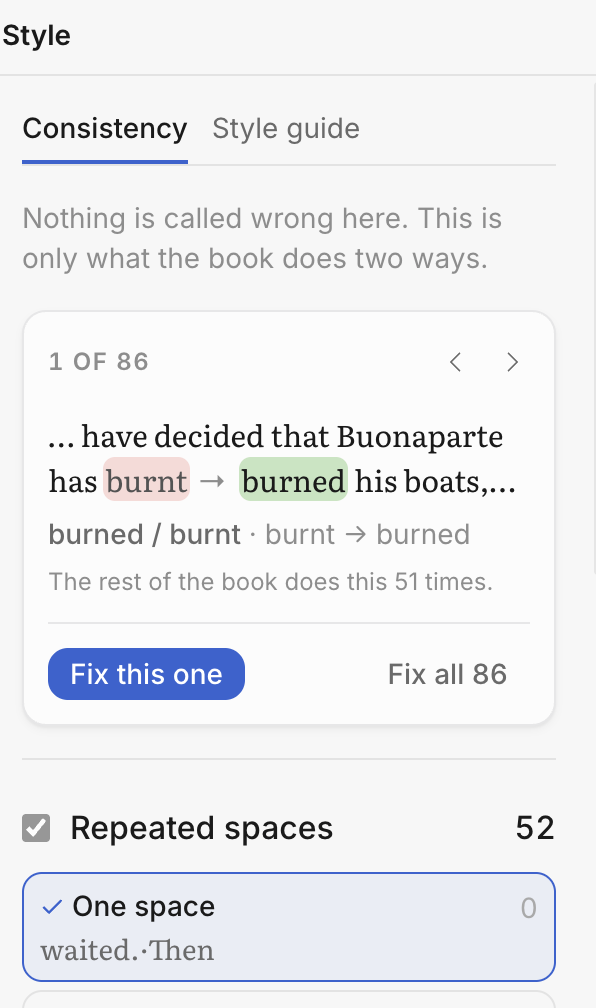
Consistency
It counts both sides of every choice the manuscript makes — burnt or burned, organise or organize, serial comma or none — and shows you the losing side. Fix one occurrence or all eighty-six. Name Chicago or New Hart's Rules and it holds to it.
Around forty rules, three spelling traditions — American, British and Oxford — and it counts what you do right as well as what you do twice.
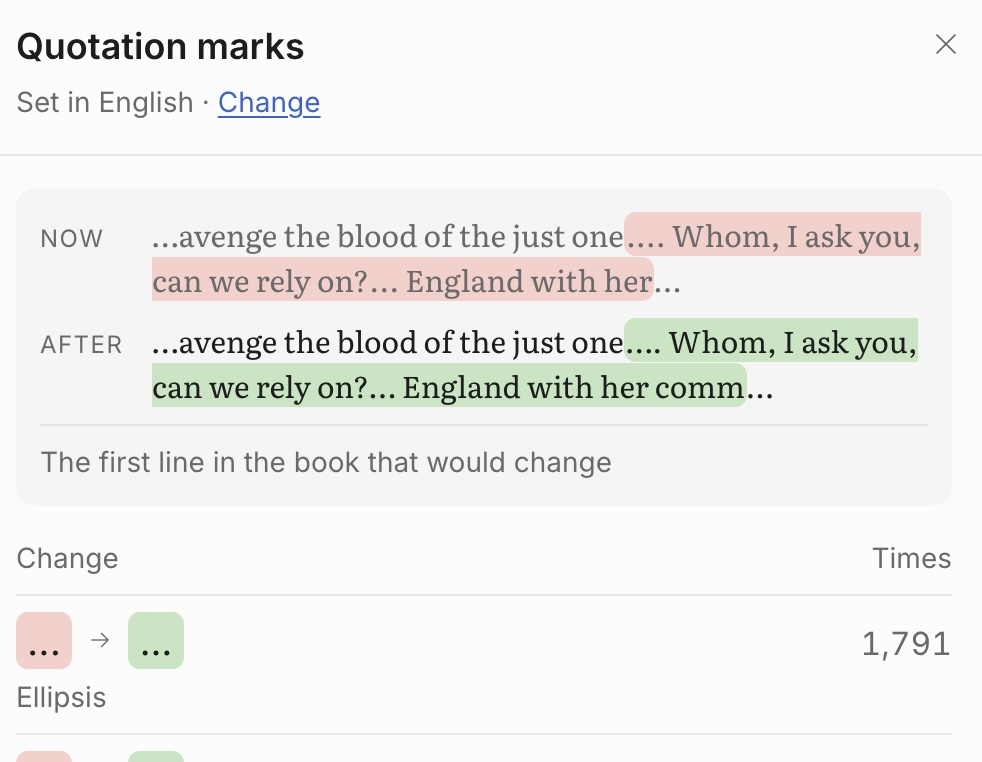
Typography
Straight quotes pair up, double hyphens become dashes, three dots an ellipsis — in your book's own language. A French book gets guillemets with the narrow spaces inside them, a German one its low opening quotes. You see the first line that would change, and the count for every substitution, before it touches a word.
Five languages. Running it twice changes nothing, and one undo takes the whole book back.
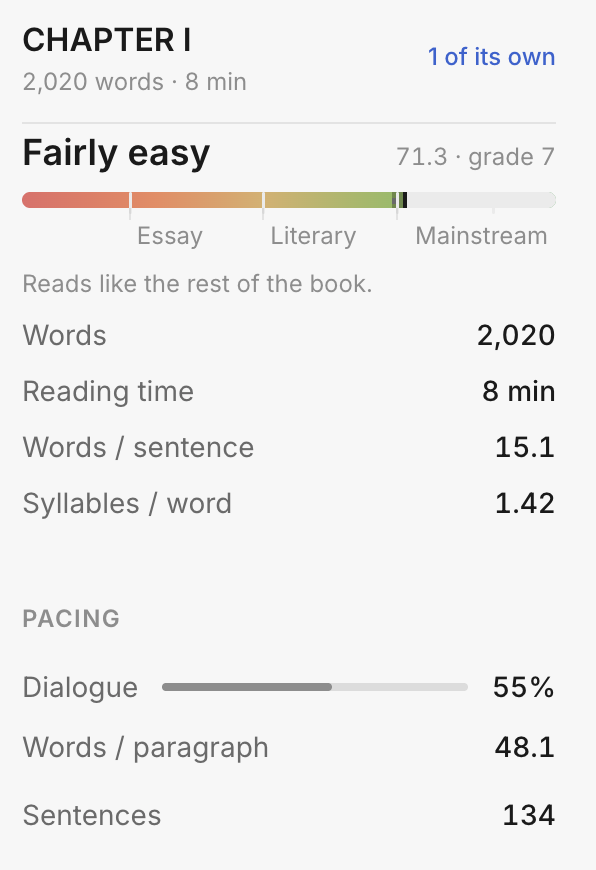
Readability
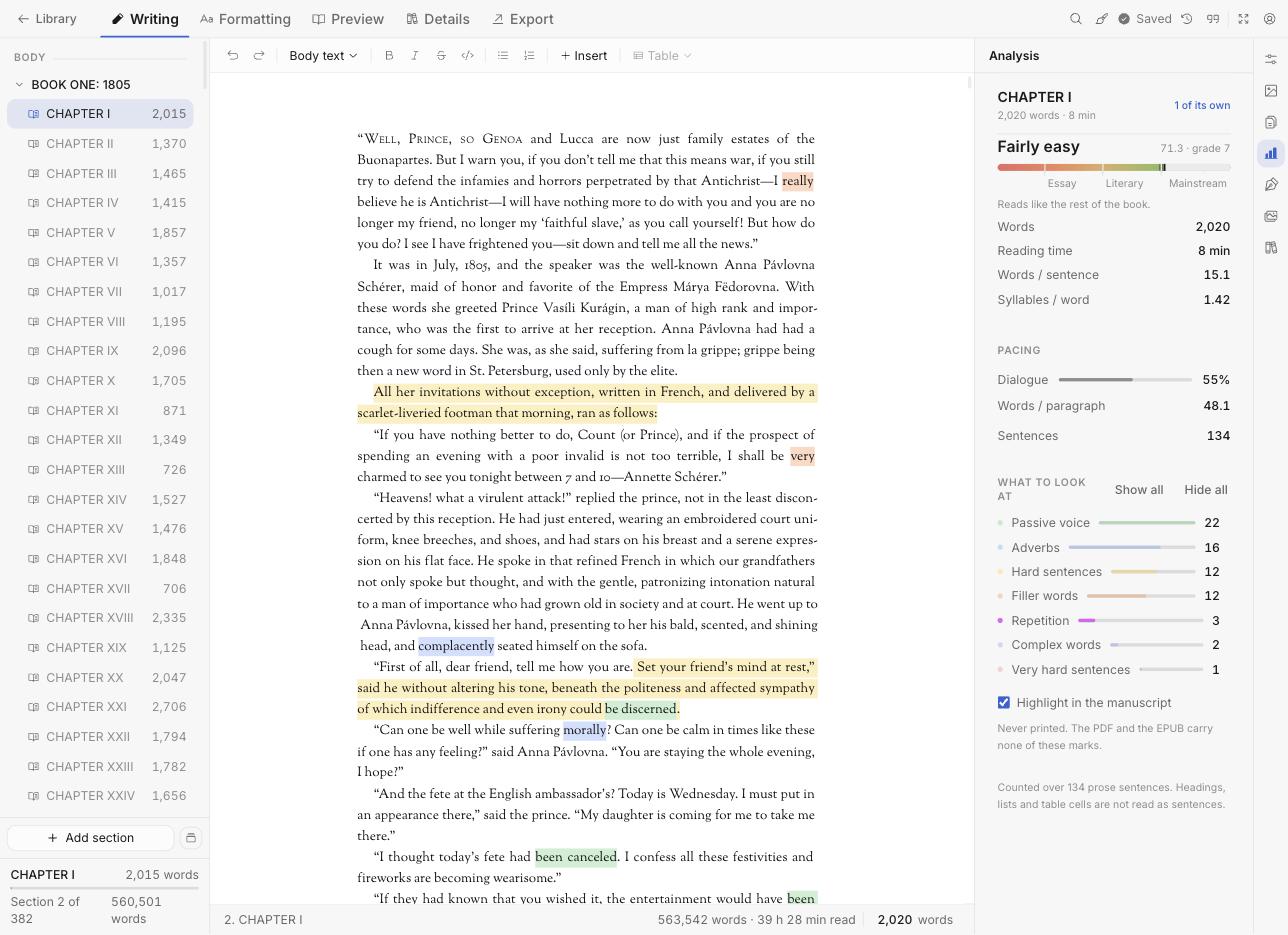
How hard the chapter is going, scored against the rest of your own book. How much of it is dialogue. Then the adverbs, the passives, the filler and the sentences a reader will take twice — marked in the manuscript, where you can fix them.
English only, for now. None of it is printed: the PDF and the EPUB carry no marks.
Every save, grouped by day. Restoring re-applies a version as a new edit, so nothing since is discarded.
Edits save to your own machine as you type; pagination and export run in the browser.
Every chapter at once. A result opens at the sentence, with its context around it.
Notes that split across a page break and renumber from where the call falls — at the foot of the page or gathered at the back.
Cite a source once and it appears in the bibliography, ordered and formatted.
A table longer than a page carries its header row onto the next.
In the flow, across the measure or full page, with text wrapped to the silhouette. Resolution checked before export.
Designed beside the book, spine width derived from page count and paper. Change the book and it tells you the cover has gone stale.
One per chapter, filling up in the status bar beside the book's total.
Any family on Google Fonts, each checked for embedding rights before the PDF is written.
Real hyphenation patterns, so justified text holds without rivers of white.
Pagination and export run in the browser; no third-party service ever sees the manuscript. Syncs to your own account, so the book follows you between machines.
No setup, no template to fill in, nothing to learn first. The whole of it happens in the browser tab you already have open.
The Word document you have been writing in, or Markdown. Nueel reads the structure you made — your headings become chapters, your italics stay italic — and shows you what it found before it changes a word. Half a million words open without freezing.
2 minutes
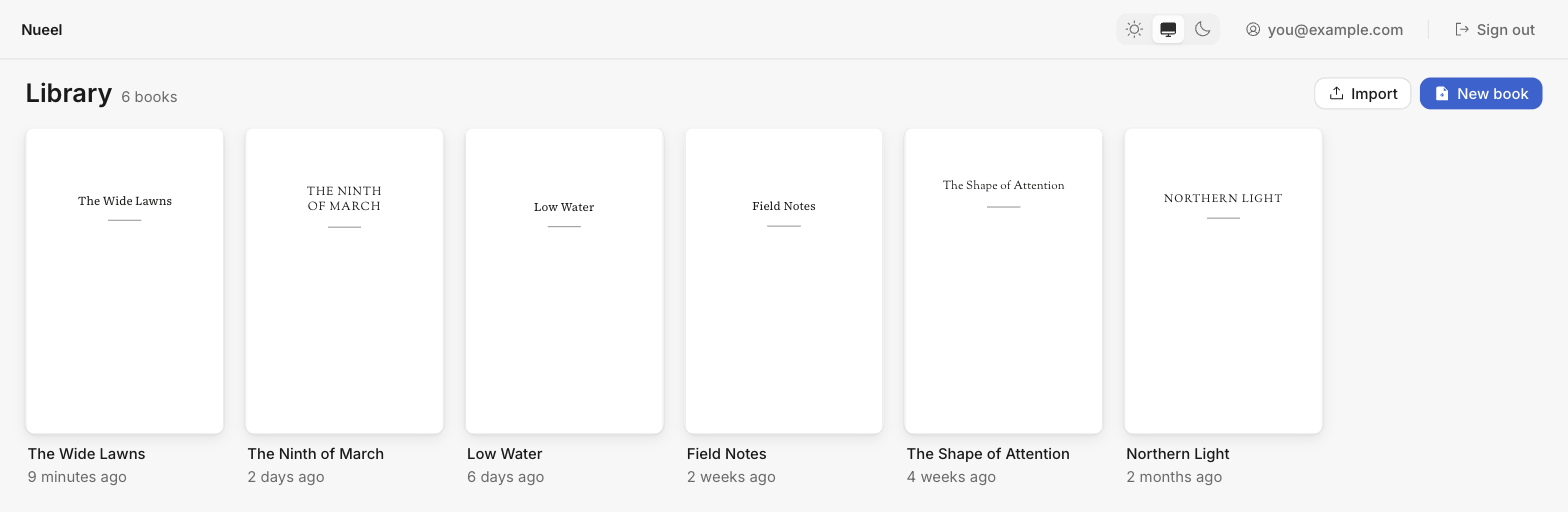
Eighteen finished book designs, from literary fiction to academic. Click one and the whole manuscript takes it at once — every margin, every chapter opening, every running head. Keep it exactly as it comes, or change any measurement in it.
5 minutes
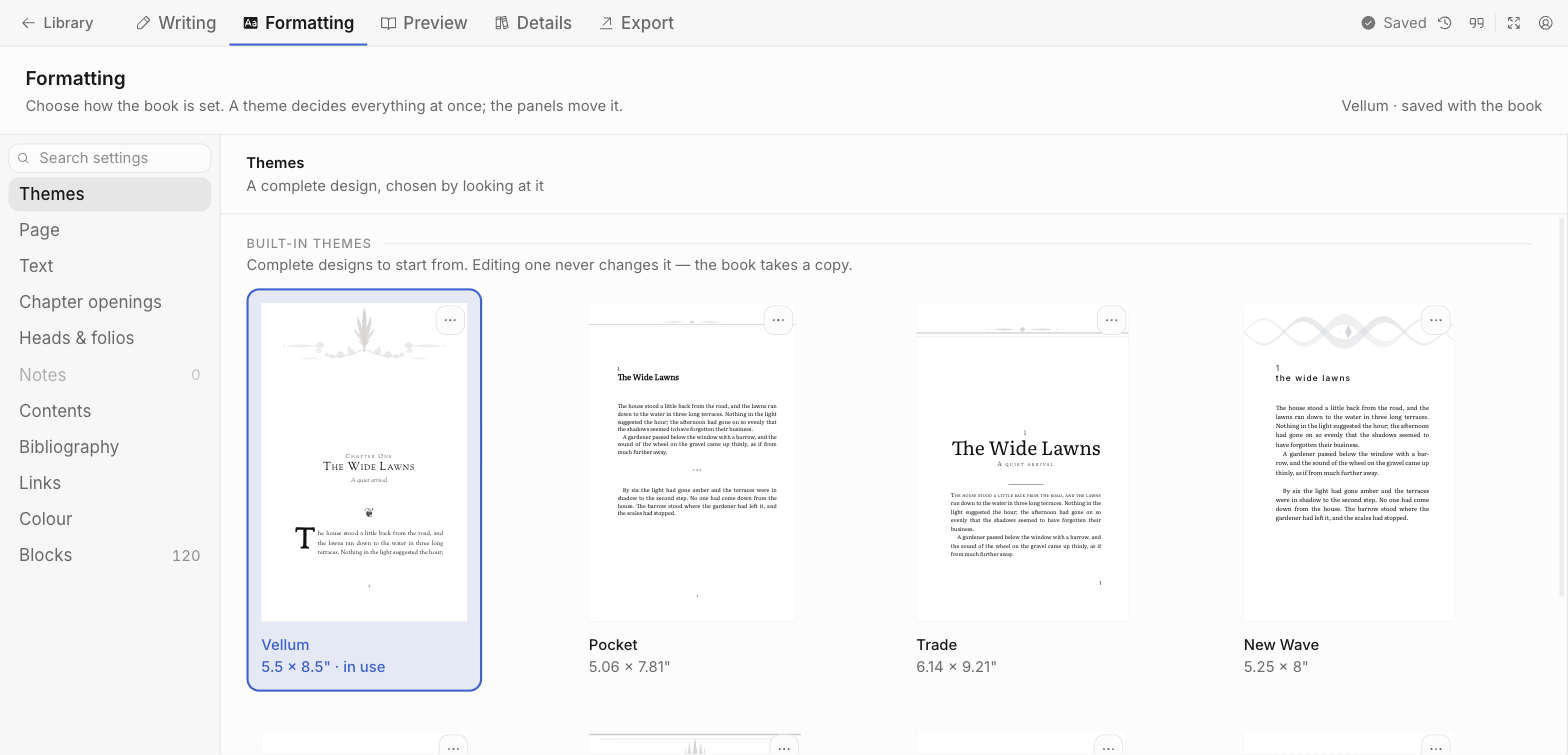
Page through the real thing at the size it will print, as facing pages, or on a Kindle-shaped screen. This is the same engine that makes the file, so what you approve here is what the printer receives.
as long as you like
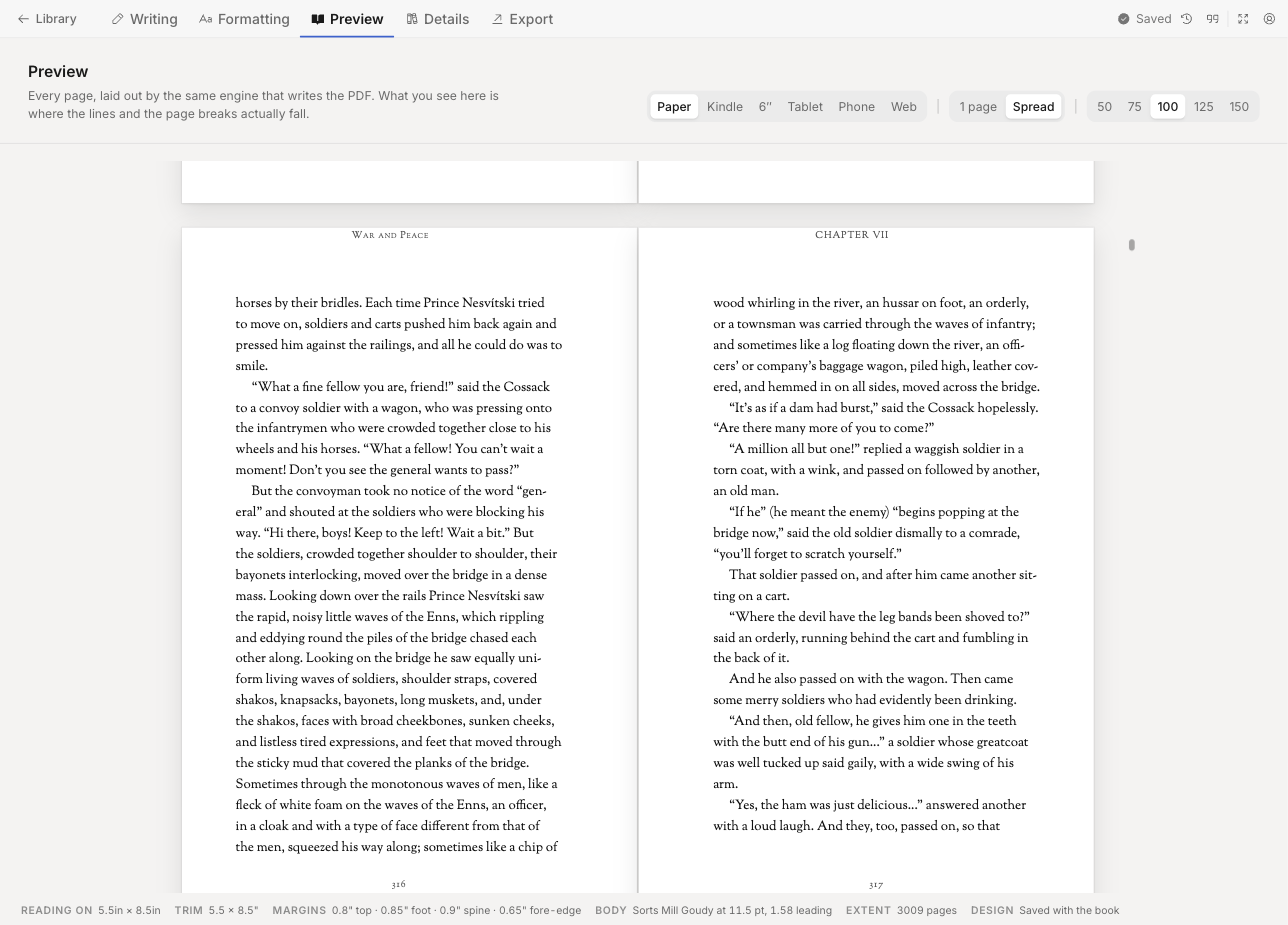
A print-ready PDF, an EPUB and a Word file — each one checked against your shop's own requirements, with the page number of anything wrong, before it leaves your machine. KDP, IngramSpark, Apple Books and Kobo.
1 minute
A design is a starting point you are never locked into. Every measurement in the book is yours to change, from the trim size and the typeface down to the tracking on a chapter title and the ornament between two scenes. Change one thing or rebuild the whole design; the book repaginates as you go.
Set the book in any family on Google Fonts, on top of the faces that ship with it. Save what you built as your own theme and set your next book in it in one click.
Book software usually starts fast and ends up making you wait on every keystroke. Nueel is developed against War and Peace — all of it — and these are the numbers the layout engine produces on an ordinary laptop. The same engine runs in your browser; nothing is sent to a server to be paginated.
A formatter charges $300 to $1,000 for one book. Nueel costs less than that once, and it sets every book you write from here on.
Launch sale — 25% off for a limited time
Nueel — the whole studio
$104.25$139
One payment, no tax added
Get NueelFourteen days to change your mind. Refunded in full, no questions asked.
That is what the export checks are for. Before a file leaves, Nueel verifies trim size, bleed, margins, embedded fonts and image resolution against the requirements of the shop you are publishing to, and tells you on which page anything is wrong. KDP, IngramSpark, Apple Books and Kobo are covered.
No. $104.25 once (25% off launch price, normally $139), and it is yours — every book you ever format from it. A subscription would put your manuscript behind a monthly payment, and a formatter that can hold your book hostage is the wrong shape for something whose first promise is that you never lose anything.
No. Nueel reads the structure you already made: your headings become chapters, your italics stay italic, your scene breaks are recognised as scene breaks. What it discards is Word's visual formatting, which is the part you want replaced.
No. The 18 designs are complete and finished; picking one is the entire required workflow. Everything else is there when you want it and stays out of the way when you do not.
There is no trial account — but the home page is not a mock-up either. The before-and-after at the top is a real Word file you can download and the exact book Nueel makes of it, and every design specimen was typeset by the same engine that will set your book. Look at what it does before you decide; the fourteen-day refund does the rest.
Not to work. Every edit is saved on your own machine as you make it, and pagination and export run in your browser — you can format an entire book on a plane. You need the network to sign in, to load the app the first time, and to reach version history older than the last few hours.
It is developed against War and Peace — 563,542 words, 3,009 typeset pages — which lays out in about three and a half seconds and re-pages in forty milliseconds after an edit. Your book is almost certainly smaller.
Any family on Google Fonts, on top of the faces that ship with the app, and each is checked for embedding rights before the PDF is made. Images and manuscript sync to your own account so the book follows you between machines; nothing is handed to a third-party conversion service.
How to get a refund, and the questions that arrive after you buy, are on the FAQ.